
Stripe: the developer experience that reset the standard
I spent an important part of my career at PayPal, so I come to Stripe's story with a lot of respect for the people who made internet payments possible before it arrived. PayPal taught the web that money could move online, Braintree pushed payment APIs and mobile checkout forward, and Stripe inherited that work and changed what developers expected from the whole experience.
This is the first post in Building for Developers, a series about products that raised the bar for developer platforms and the people who built them. I want to understand those choices, including the small ones that are easy to dismiss as polish, and carry the useful parts into the SDKs, APIs, and platforms I work on today.
The API deserved the attention it got, but the reason Stripe stood out to me was how complete the rest of the experience felt. My test key was already in the example, errors usually pointed me toward the next step, and when I got stuck I could ask someone from Stripe a question in IRC. The company spent time on the last 5%, the parts most companies left rough or promised to fix later. It added up to one of the best developer experiences of all time. Ask a room of developers who does developer experience well, and Stripe will be one of the first two names you hear.
The payment APIs were already there
By 2011, developers could accept cards through gateways, PayPal, and Braintree. PayPal Payments Pro let merchants keep checkout on their own sites, while Braintree had good APIs and a vault. Stripe entered a capable market with decades of payment infrastructure beneath it.
Integrating the pieces could take a while. A developer might need a merchant account, a gateway, separate test credentials, a recurring billing product, and enough PCI knowledge to know where card data could travel. PayPal's easiest path centered the PayPal wallet and checkout. The customizable path split Direct Payment and Express Checkout across NVP and SOAP APIs. PayPal's public REST API became globally available in 2013, two years after Stripe's launch.
There was a real, 430-page PayPal For Dummies book, with chapters on the Sandbox, integration, and the APIs. PayPal's own 169-page SOAP API reference devoted roughly 60 pages to tables of error codes, messages, and corrective actions. I remember documentation like that well. It showed how much machinery stood between an idea and a working payment.
Stripe saw the opening. When Patrick and John Collison publicly launched Stripe in September 2011, one account covered processing, stored cards, subscriptions, and payouts. A developer could keep checkout on the merchant's site, send card details directly to Stripe, and use the same API shape in test mode before moving real money. The launch price was 2.9% plus 30 cents, right in line with PayPal, and contemporary coverage shows how Stripe pulled those pieces together.
Seven lines and the first small win
The old Stripe homepage showed a short curl request that created a charge. Years later, Bloomberg put "seven lines of code" across a magazine cover, a phrase Stripe would spend years explaining.
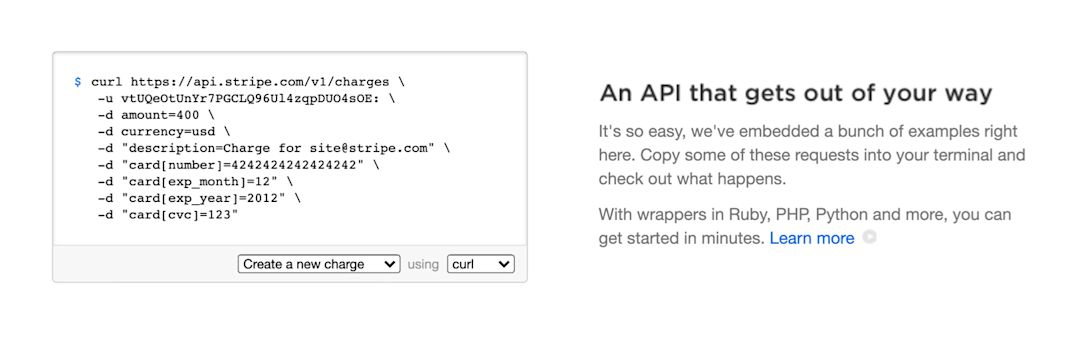
Stripe's early homepage put a working charge request beside the words "An API that gets out of your way." Image from Stripe's history of its payments API.
Stripe's history of the payments API, written by Michelle Bu, says the 2011 example had nine lines, or seven after removing two optional fields. Production still required a checkout, error handling, fulfillment, and a plan for failed requests.
The number was beside the point. You could open a terminal and see a successful Charge object come back. Money had seemed buried behind paperwork and bank vocabulary, and here it answered a command.
That small win still matters when I build a developer platform because Stripe let people feel the product before asking them to learn the entire payments business.
It felt like someone was home
Stripe's docs looked good, and the care ran deeper than typography. The Checkout quickstart kept the walkthrough and sample code in sync. As you scrolled through the steps, the matching code stayed beside the prose and the relevant lines were highlighted. You could switch languages without losing your place.
It is easy to take this for granted now. Before Stripe, testing a payment API usually began with account setup. PayPal's NVP/SOAP sandbox required sandbox accounts, a separate API username, password, and signature, and the correct sandbox endpoint before the first call could succeed.
Stripe made the first run much smaller. Once you were signed in, the docs inserted your test API key into the example and kept test cards, including 4242 4242 4242 4242, within reach. You could copy the request and see a successful response in minutes, sometimes seconds. Stripe's docs handled setup that competitors left to the developer. The experience was designed around an early win, before the developer had time to lose momentum.
A product manager could write these off as finishing touches. During an integration, they saved constant scrolling, copying, and hunting. Most API references I knew felt like manuals. Stripe put world-class product design into developer documentation, with the same attention to layout, interaction, and finish that you would expect from a consumer application. No companies were putting this much care into their developer docs before Stripe.
There was personality too. For years, developers could join #stripe on IRC and ask a technical question, and Bu recalled helping users there while she was building Stripe's payment APIs. Today the docs point developers toward Stripe's Discord server for live technical conversation.
If you got stuck, the next step could be walking into IRC and asking the person who might have named the object in your error message. Most payment systems felt like locked doors with ticket slots. Stripe felt inhabited, and the person replying might know why the object had that name or where the integration was likely to break. The support model came close to saying, "Talk to a developer."
Payments are intimidating, and Stripe borrowed familiar cues from developer tools: terminal prompts, test keys, compact object names, and keyboard shortcuts. Together, they made the payment system easier to approach and much easier to remember.
Polish belongs in the infrastructure
Developers experience a platform through hundreds of small interactions, from the API call and test card to the request log and five minutes spent looking for a credential, and Stripe kept working on those seams.
The Stripe CLI, released in 2019, could forward webhooks to localhost with stripe listen, generate test events with stripe trigger, and stream API traffic through stripe logs tail. A developer debugging an asynchronous payment could see the request, receive the event locally, adjust the handler, and try again from the terminal.
At the time, this was revolutionary. I had never seen another platform put this much polish around the full developer loop.
In 2022, Stripe put a hosted terminal UI and API Explorer inside its documentation. Pressing the backtick key opened Stripe Shell. You could run a test request while reading the guide, inspect the response, and print the equivalent SDK code without preparing a local project.
Workbench, released in 2024, pulled the same idea into the Dashboard. Press ~ from anywhere and it opens. The Inspector connects a Customer, Payment, or Subscription to its JSON, related objects, requests, and events. Shell uses familiar Bash shortcuts. The API Explorer builds a request and shows its SDK form.
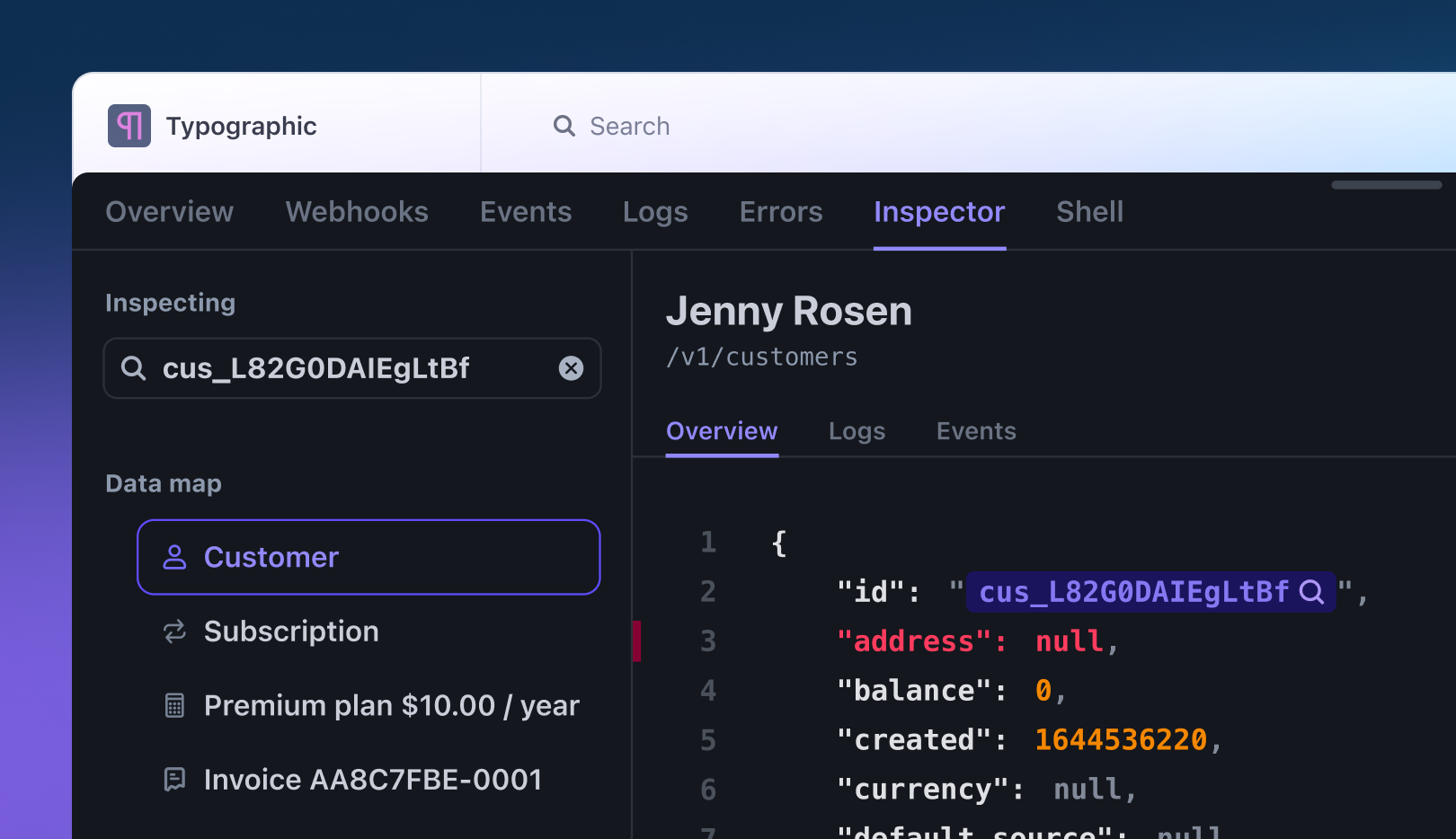
Workbench's Inspector connects a Stripe object to its related data, JSON, logs, and events. Image from Stripe's 2024 Workbench launch.
I love that level of care. A keyboard shortcut can sound trivial beside payment processing, but it tells the developer that their time has been considered. I've lost afternoons to five-minute interruptions. Saving a few of those moments keeps me focused on the payment bug I sat down to solve, and that same care affects whether I send a platform its first production request.
One Stripe
The API, docs, Dashboard, SDKs, CLI, logs, and webhook tools feel like parts of the same product. A PaymentIntent in the guide is the object you inspect in Workbench and the event you forward to localhost. Test mode follows the same path while keeping real money out of it.
Stripe's internal team boundaries stay backstage. A developer can trace a failed invoice without first learning who owns Billing, Connect, API versioning, or the Dashboard because Stripe handles those connections on its side of the screen.
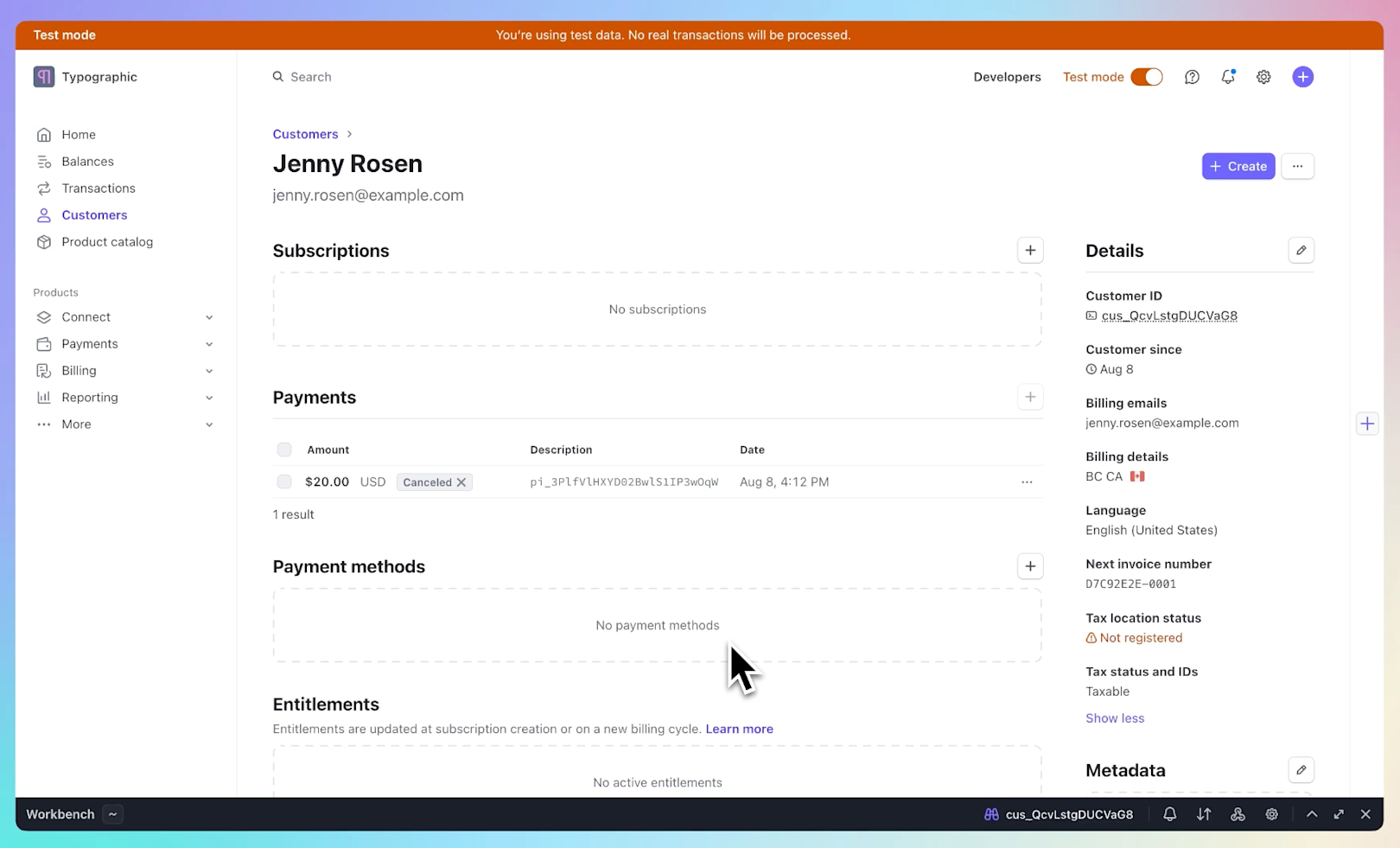
Workbench stays available inside the Dashboard as a developer moves through the product, shown here in Stripe's 2024 launch post.
Plenty of companies ship their org chart to developers. Authentication changes by product, SDKs follow separate release policies, documentation uses names the API never returns, and support passes the question between teams. I end up translating the company instead of working on my integration. Stripe's shared primitives and cross-product standards save me from doing that work.
The tenth year of the integration
Dated API versions were another Stripe innovation. Historically, an account's first API request pinned it to the newest rolling version, such as 2017-05-24. Stripe kept returning that version unless the developer explicitly sent a different Stripe-Version header or upgraded the account. Existing code kept the response shape it was written against.
That was a big deal. Stripe could keep improving the API without dropping breaking response changes into working production code. In 2017, Brandur Leach explained how Stripe generated the current response and then applied small version-change modules backward until it matched the requested date. When a verified boolean became a status field, for example, older integrations kept receiving verified. The docs also recognized the account's version and warned when the reference had moved ahead. When Leach wrote the post, Stripe had maintained compatibility with every API version since 2011, and proposed changes went through API review before release.
Stripe changed the release cadence in 2024. Monthly versions now stay backward-compatible within a named major release, while breaking changes arrive in twice-yearly major releases and require an explicit upgrade.
Stripe also made idempotency keys part of the everyday API. If a connection drops after a charge request, the client may have no idea whether the server completed it. Retrying with the same key lets Stripe return the earlier result instead of charging the customer twice. The idea came from distributed systems. Stripe made it easy to use on a public API, taught developers why it mattered in plain technical writing, and treated versioning, retries, event delivery, request IDs, and migration tools as part of the integration after launch.
The organization behind the experience
The Collisons stayed close to the first integrations. In what became known as the Collison installation, Patrick or John would take an interested founder's laptop and help install Stripe, watching each place the setup slowed down.
That closeness survived in the culture around API review, technical writing, developer support, and product engineering. Stripe's current operating principles put "create with craft and beauty" next to "collaborate egolessly." Those two explain a lot. Craft makes polish part of the job. Egoless collaboration means no fiefdoms and no "not my problem." The API, Dashboard, docs, SDKs, support, and CLI can share a vocabulary because the work crosses team boundaries.
"Move with urgency and focus" helps explain why Stripe keeps shipping tools around a mature API. The principle calls for speed on the work that matters and investment in anything that makes the team faster tomorrow. "Stay curious" fits the engineers, writers, and support people who keep following small integration problems until they understand them.
What I carry forward
Stripe makes me look beyond the endpoint when I evaluate a developer platform. I pay attention to the entire path from the first code sample to the tenth year of the integration: how quickly a developer gets a real result, whether an error tells them what to try next, whether request logs make it easy to trace a failure back to the payment, customer, or webhook involved, and whether the docs, SDK, CLI, Dashboard, and support team all speak the same language. Test mode needs to build confidence in production, upgrades need to preserve trust, and the last 5% needs to make it obvious that someone cared.
I also notice when a developer tool has some personality. Stripe's terminal-inspired docs, keyboard shortcuts, and access to a real developer on IRC made the experience feel familiar and human. Those details were memorable, but they also showed how closely Stripe paid attention to the people doing the integration. I still value that today when someone answers in Discord after an integration breaks.
When I work on an SDK or API, I now pay attention to the paths between products and the vocabulary teams share. A customer should be able to finish the task without reconstructing the company that built it.
Thank you, Stripe. You showed the rest of us what a developer platform can feel like when the API, docs, tools, support, and final details are treated as one product.